0 to 45% Share of Voice in AI Answers: A Case
Jump to section›
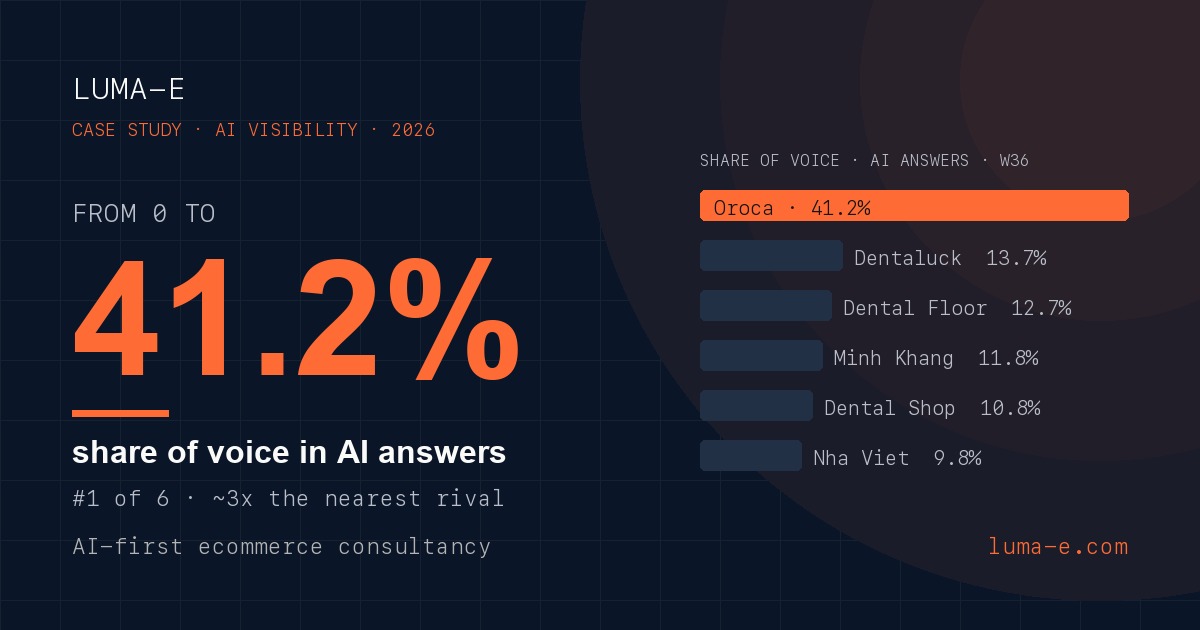
Short version: Buyers increasingly ask an AI assistant "who's a reputable supplier?" before they ever open Google. If the AI doesn't name you at that step, you lose the buyer before they reach your site. Oroca, a B2B dental-materials distributor in Vietnam, launched a brand-new site built to be AI-visible from day one — starting, like any new site, at share of voice zero. By week 37 of 2026, measured on a dashboard we built, Oroca held 45.0% share of voice in its category: number one outright, more than the next three competitors combined — a line that climbed 0 → 41.2% → 45.0% over consecutive weeks. Here's the method behind that number, before the number itself — because the method is the part you can reuse.
#The question most brands can't answer
"When someone asks ChatGPT or Gemini for a supplier in our category, do we show up?"
Most brands can't answer it — not because the answer is bad, but because nobody measures it. The buying journey now starts one step earlier than the website: a shopper asks an assistant to shortlist suppliers, and the brands the assistant names are the only ones that make the next round. If you're not measuring whether you're named, you're flying blind on the single moment that decides the shortlist. You can't move a number you don't measure.
#The starting point: zero
Oroca is a B2B dental-materials distributor in Vietnam, serving buyers in Ho Chi Minh City and Hanoi. Its site was a brand-new build — and a new site, by default, isn't present in AI answers for category buying prompts: the questions a clinic or a purchasing lead actually types when they're looking for a supplier. Share of voice was essentially zero. Not low. Absent.
That's the honest baseline, and it matters, because the interesting part isn't the destination — it's that the whole thing was measured from a known starting point, on a site designed to be machine-readable for AI from day one rather than retrofitted later.
#What we measured — the method, before the result
Before any result is worth reading, here's exactly how it was produced:
- A set of 30 category prompts reflecting real B2B buying intent — "where to buy reputable dental materials in HCMC," "authorized distributor in Hanoi," "top dental-materials distributors in Vietnam." Not brand-name searches; the questions a buyer asks before they know who to trust.
- Run weekly on ChatGPT and Gemini, logging every mention and every citation, each one tied to a specific prompt, a specific engine, and a specific week.
- On a dashboard we built ourselves (
visibility-dashboard.orotech.cloud) — not a screenshot of some third-party tool's report. Which means the client can click into any number and see the prompt, the engine and the week behind it.
That last point is the difference that matters. We don't sell "AEO services" and hand you someone else's tool's summary. We build the measurement first, then move the number — the same way we approach correctness work like Home Elegance USA, where four AI agents reported in-stock furniture as backordered. Share of voice is one axis of AI visibility; correctness is another. Both start with a measurement you can check.
#The result (week 37, 2026)
Measured on the dashboard, for the category, in a single tracked week:
| Brand | Mentions | Share of voice |
|---|---|---|
| Oroca | 49 | 45.0% |
| Dental Shop | 15 | 13.8% |
| Dental Floor | 13 | 11.9% |
| Minh Khang Dental | 11 | 10.1% |
| Nha Viet Dental | 11 | 10.1% |
| Dentaluck | 10 | 9.2% |
Reading the table:
- Share of voice 45.0% (49 mentions) — number one outright in the category.
- More than the next three competitors combined (49 mentions versus 39), and roughly 3.3 times the nearest rival at 13.8%.
- AI mention rate 82% across the tracked prompts — 27 answers cited Oroca, 22 more mentioned it.
- By engine: ChatGPT 76.7%, Gemini 86.7% — present on both, strong on each.
- A rising line, not a one-off: 0 at launch → 41.2% in W36 → 45.0% in W37, tracked weekly on the same 30 prompts.
#Why this holds up when a buyer checks it
The reason to trust a number is that it survives someone poking at it. This one is built to:
- It's a measurement, not a testimonial. Every mention is pinned to a prompt, an engine and a week. There's nothing to take on faith — you open the row and look.
- It names the competitors standing next to it. A visibility number only means something with something to compare against. This one lists the five rivals and their shares, so 45.0% has a context, not just a nice ring.
- It runs weekly, so there's a trend. One good week could be luck. A tracked line over repeated weeks on the same prompts is a position, not a screenshot.
#What this means for your store
The first step in "AI visibility" isn't optimization — it's measurement. Most of the work sold under this label skips straight to tactics no one can verify: schema tweaks, content, entity signals, all with no baseline to prove any of it moved the needle. Start instead by measuring where you actually stand in AI answers today, competitor by competitor, on the prompts your buyers really ask. Then move it.
We're not promising you 45%. Oroca's category, starting point and competitive field are its own. What travels is the method: measure first, name the competitors, track it weekly, and only then decide what to fix.
Want to know where your store stands in AI answers right now? Send one store URL and we'll run a free async AI-visibility read — we ask live AI assistants the category questions your buyers ask and send back where you actually appear versus your competitors, mention by mention: luma-e.com/ai-readiness. No call required.