The Listicle Gap: Why DTC Brands Win AI Citations and Direct-Reply Brands Don't
Jump to section›
Ask ChatGPT or Perplexity to recommend brands in a category — "best clean skincare", "top supplement brands", "wellness brands worth buying", "best men's grooming for sensitive skin" — and pay attention to which names come back. Then pay attention to which URLs the assistant cites when it explains why.
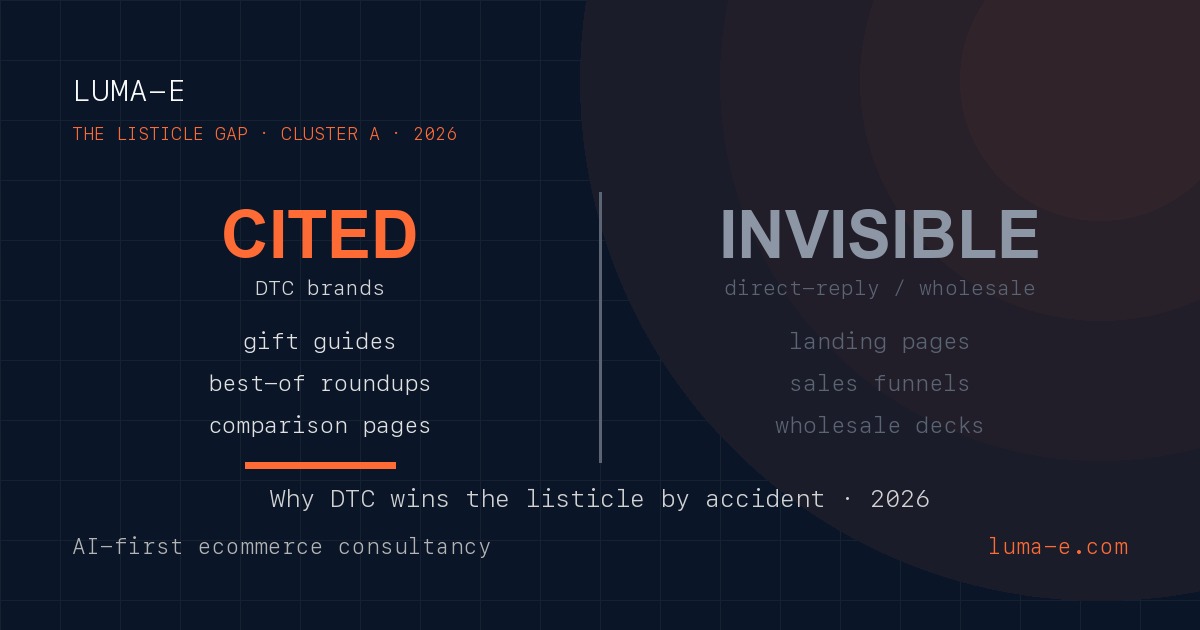
The brands the engines return are almost never the ones with the best websites. They are the ones that appear on the third-party listicles, roundups, and comparison pages the engine actually reads. That is the listicle gap. Direct-to-consumer (DTC) brands tend to win it by accident. Direct-reply, wholesale, and B2B-heavy brands often lose it — not because their product is worse, but because their marketing never produced the page format the engine cites from.
This piece unpacks why the gap exists, why DTC brands sit on the winning side of it, and how a brand that lost it can close the gap in one quarter without shifting its whole marketing model.
#Why AI engines lean on listicles
If you ask a language model to answer a category-recommendation question, it needs three things at retrieval time: a bounded shortlist, named entities to fill it, and quick rationales for each one. The output format the assistant produces looks a lot like a listicle — because a listicle already contains the shape.
Ahrefs' December 2025 research on 26,283 ChatGPT source URLs published in Best Lists Research found that list-format pages accounted for 43.8% of citations, more than any other page type in the sample. Product pages, blog explainers, and homepages combined did not clear that share. When we run our own smaller-scale audits across ecommerce category queries, we see the same shape — an assistant answering "best brands for X" pulls from roundup posts, comparison sites, and industry directories far more often than from any single brand's own site.
The mechanism is prosaic. The engine has been trained on and continues to retrieve from documents that already answer category questions. Listicles are documents that answer category questions. Brand pages are documents that answer "why us" questions. Different question, different citation surface.
#Why DTC brands sit on the winning side by default
DTC marketing already produces the raw material AI engines cite. This is not because DTC founders understood AI search early — it is because the DTC growth model puts brands into third-party editorial in ways that a direct-reply or wholesale model does not.
The typical DTC funnel over a first 24 months looks something like this. A launch generates coverage in a couple of trade publications. Founder-story angles pick up in DTC-industry newsletters. Retail-media roundups pull the brand into "best of" lists as the assortment expands. Gift guides mention the product line every November and December. Influencer roundups on skin-type, use-case, or price-tier categorisations name-check the brand as an option. Comparison writers on Wirecutter-style sites, Reddit power-users, and category directories all cover the same ground from different angles. None of this happens because the DTC brand instrumented AI visibility. It happens because DTC media relations, PR, and influencer motions all default to editorial formats that produce listicles as their natural output.
Every one of those pages is a citation source. Every mention on a Best Of, gift guide, or "Top 15" is a place an AI engine can pull the brand name from, along with a one-sentence justification the engine can paraphrase. Twenty-four months in, a DTC brand can look up and find that its name is legible in five to eight listicle formats across three or four independent domains — often without a single tactical decision made in that direction.
#Why direct-reply and wholesale brands lose it
Direct-reply and wholesale marketing produce a different kind of output. Owned-media, funnels, sales collateral, PPC landing pages, and account-based collateral all get written to convert a specific reader in a specific step. They rarely produce third-party listicles as a side effect. Trade-publication coverage tends toward "profile of" and "state of the market" pieces, not "top 10 for X". Case studies live inside the seller's own domain. Comparison content, if written at all, gets written by the brand itself and lives on the brand's own site — where an AI engine will read it as brand-owned copy, not as an independent recommendation.
The result is asymmetric. A wholesale brand with a strong product, a long customer list, and a considered marketing programme can go 5-10 years without ever landing on a category listicle. The pages the engine cites for its category do not include its name. The engine, asked a category question, cannot cite the brand — not because it doesn't exist, but because it doesn't appear on the pages the engine reads before it reaches the brand's own domain.
We see this pattern show up cleanly in audits across 50+ ecommerce projects. Verticals where DTC dominates (clean skincare, better-for-you food, direct-to-consumer supplements, sleep) show 6-8 listicle-format domains cited repeatedly across the same category queries. Verticals where direct-reply and wholesale dominate (industrial ingredients, B2B fulfilment services, specialty electrical, wholesale apparel) show a much thinner ring of citation surfaces — and correspondingly weaker AI-engine recall of brand names in the category.
#The fix has three moves, in this order
Fixing a listicle gap is not a content project on the brand's own site. It is an entity-signal project plus a placement project on the third-party pages that already get cited. Three moves, in order, produce results without asking the brand to change its underlying marketing model.
Move one: map the citation-source domains for your category. Pick 8-12 category-relevant queries covering head, mid-tail, and long-tail variations. Run each in Perplexity, ChatGPT, and any other engine your buyers use. For each answer, copy every cited URL. Sort by domain. The 6-10 domains that repeat are your citation surface. This exercise takes an afternoon and gives you a shortlist of pages you need to be on. If the same query produces zero cited URLs — the engine answered from general knowledge — that is also information; it tells you there is no strong listicle surface in your category yet, which changes the play (see move three below).
Move two: earn placement on the shortlist. For each of the 6-10 domains, decide the closest path in. Roundup articles at trade publications tend to accept pitches; pitch the writer with the specific angle the piece needs. Comparison sites often update on a rolling basis; submit through their standard channel and provide the evidence — spec sheet, screenshots, customer references — that makes inclusion low-effort for the editor. Directories usually have a submission or listing flow; complete it, fully, with schema-rich descriptions. Reddit-style power-user roundups are earned differently; participation in the community over quarters is the path, not a pitch. The point is that "getting on the listicle" is a multi-quarter placement discipline, not a one-off outreach campaign.
Move three: reconcile your entity signals so the citation lands cleanly when it arrives. When a listicle mentions your name, the AI engine needs to attach the citation to a single, clean entity. If your Organization schema says one location, your llms.txt says another, your LinkedIn page says a third, and your knowledge-panel data disagrees with all of them, the engine will pick — sometimes badly. Fixing entity drift takes an hour of codebase work; leaving it broken can mean an earned listicle placement fails to translate into a citation, because the engine can't decide which entity to attach it to. We wrote up our own version of this fix in How a Shopify Brand Goes From 0 to 2 AI Citations in 30 Days — same principle, applied to a brand that had zero category citations for exactly this reason.
The order matters. Placement without clean entity signals leaks half the citation lift. Entity signals without placement produces a well-organised brand the engine cannot cite because no third-party page mentions it. Query mapping without either of the above is theatre — you know the surface but haven't earned position on it.
#What "closing the gap" looks like across a quarter
A realistic first-quarter target for a direct-reply or wholesale brand looking to close a listicle gap is one to three earned placements on category-relevant domains, plus clean entity signals across owned surfaces, plus a documented map of the 8-12 citation-source domains for the category. That combination produces enough surface to start generating category-query citations by month three or four, on the same timeline the engines take to retrieve and reweight against new inputs.
What it does not look like is a spike. Citation lift on category queries lags placement by weeks, sometimes months, and depends on the engine's next retrieval cycle. Anyone promising you a citation appear inside a fortnight is either running a test on a very cold query or overpromising. The compounding curve is worth the honesty — we measure it on our own domain and see the shape clearly, first cite around day 21 after signal repair, second around day 28, then a gap until further placements land.
#Common objections, briefly
"We ran PR five years ago and it didn't move the needle." Different objective. PR five years ago was optimising for referral traffic and brand awareness. Listicle placement now is optimising for the specific URL formats an AI engine cites from. The tactical output may look similar (a mention on a roundup); the KPI is different (does the mention show up in a category-query citation, not does it drive click-throughs).
"Our category doesn't have listicles." Sometimes true; usually the query framing needs work. Head-of-category queries in industrial or specialist verticals often return general knowledge because no strong listicle exists. Mid-tail and long-tail queries in the same vertical almost always do have listicle surfaces, in trade publications, association directories, and specialist comparison sites. The audit exercise in move one surfaces this; if it genuinely returns zero surfaces after a full sweep, the play changes from placement to creation — commission a comparison piece from a trade publisher, or take the position of being the first credible category directory in the vertical.
"We can't influence what a third-party editor writes." Correct. You influence what evidence they have to work with. Editors write from what is in front of them; if your product, customer references, and evidence are more legible than a competitor's, you land in the piece. Getting there is a placement discipline, not a control problem.
"Isn't this just AI-flavoured link-building?" Overlap is real (both value third-party editorial), divergence is real (citation-first cares about entity legibility and page format, not the dofollow attribute). Teams that treat listicle placement as a link-building tactic tend to under-invest in the entity-signal reconciliation step and leak half the return.
#What we're tracking next
We keep a live citation log for our own domain and publish the deltas quarterly. The next thing worth watching is whether the domains AI engines cite for a category shift materially as more brands wake up to the listicle gap and try to close it. Our current expectation is that the source-domain shortlist consolidates rather than expanding — engines tend to prefer high-authority, editorially-curated surfaces once they exist, and that concentration means the placement bar goes up over the next 12 months even as awareness of the surface goes up.
If your brand is on the losing side of the listicle gap today, the leverage of closing it is highest in the next two quarters, while the bar to earn placement is still low relative to where it will be by end of 2026. After that, the same domains that let you in now will have more brands chasing them.
#Sources and further reading
- Ahrefs, Best Lists Research (Dec 2025) — 26,283 ChatGPT source URL analysis, 43.8% listicle share
- LUMA·E, How a Shopify Brand Goes From 0 to 2 AI Citations in 30 Days — internal audit log showing entity-signal fix + citation lift
- LUMA·E, Why Your Shopify Store Isn't Cited by ChatGPT — five structural gaps and the 30-day fix sequence
- LUMA·E, The AI Visibility Score — reproducible audit method with the 12-query framework used to map citation-source domains