Why I Stopped Calling It a Solo Agency: The AI-First Reframe and What It Cost Me
Jump to section›
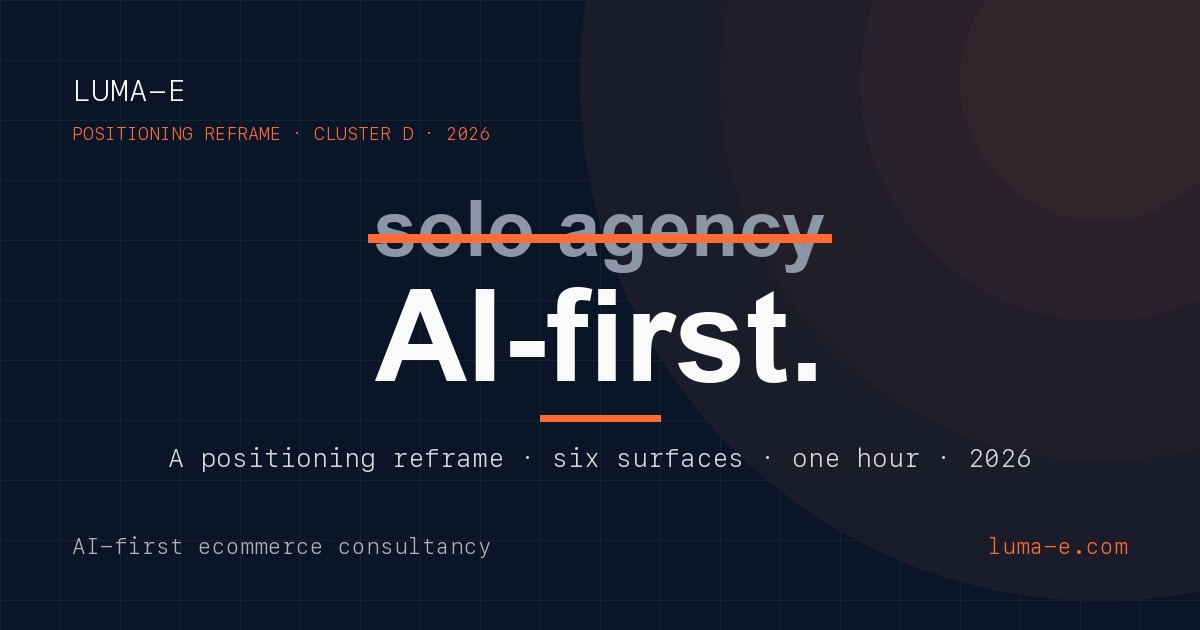
I used to call it a solo agency. Last week I stopped, and rewrote the phrase across six surfaces in about an hour. The edit was trivial. The month of reasoning behind it was not.
This is the build-in-public version of a positioning decision — the collision that forced it, what I actually changed, what it cost, and what I would tell another founder weighing the same move. If you run an AI-first operation and you have been describing it by its headcount, this is the argument for describing it by its operating model instead.
#The phrase I started with
When I rebuilt my ecommerce consultancy around a stack of AI agents, the shorthand I reached for was "solo agency." It was honest. There is one human — me — and the work that used to need a team of a dozen now runs through scheduled AI agents that draft content, monitor engagement, triage the pipeline, and enforce quality gates. "Solo" captured the surprising part: the headcount.
For internal use, the label was fine. It was a codename, a way of talking about the project to myself. The problem started when the same phrase leaked into the public surfaces — the site copy, the schema, the way I described the business to people who might hire it.
Because "solo agency" answers the wrong question. A prospect does not care how many people I employ. They care whether the work will be good, whether it will be fast, and whether someone is accountable when it is not. "Solo" speaks to none of that. Worse, it invites the exact objection I did not want: if it is just one person, can it actually deliver?
#The collision
The deeper problem surfaced when I started auditing how the brand resolved in AI search.
I run a recurring citation audit — a nine-query sweep across the terms a prospect might use, checking whether the brand shows up in AI answers and, when it does, whether the facts are right. Somewhere in that process I noticed that "solo agency" as a category phrase was increasingly resolving to a named product in the space, not to the descriptive meaning I intended.
That is a semantic collision. The words I was using to describe my business were already owned — strongly, and by something better known than me. When an AI engine is asked about the category, it does not weigh my descriptive intent against a product's brand equity and rule in my favour. It surfaces the entity that owns the phrase.
So every time I used "solo agency" in public copy, I was pouring a little more signal into a phrase I could never win. The label was not just weak. It was actively working for someone else.
#Why "AI-first" wins the frame
The replacement I landed on was "AI-first." It is not a headcount claim. It is an operating-model claim, and that turns out to matter on three axes.
First, it describes the actual differentiator. The interesting thing about the business is not that there is one person. It is that the work is planned, produced, and quality-gated by AI agents with a human owning the judgment calls and the accountability. "AI-first" points at the machinery. "Solo" points at the org chart.
Second, it answers the prospect's real question. "How does the work get done, and why can it move faster without getting worse?" is the question behind most sales conversations in this category. "AI-first" opens that conversation instead of triggering the headcount objection.
Third — and this is the part that took me a month to trust — it is a phrase I can own in AI search. It is distinctive enough to resolve to my brand when the surfaces agree, and it does not collide with a dominant named product the way "solo agency" did. The citation moat is not built by using the most common words. It is built by using consistent, distinctive words across every surface an engine reads.
#The six surfaces I rewrote
Once the decision was made, the implementation was almost anticlimactic. Positioning lives in more places than a homepage, and a reposition is only real when every surface agrees. Here are the six that carried the old phrase:
The Organization JSON-LD emitted server-side on every page — the structured description an AI engine reads first.
The llms.txt and llms-full.txt files at the site root — the plain-language brief written specifically for AI crawlers.
The on-page trustLine — the one-sentence descriptor that appears in the hero and repeats in the layout.
The footer and about copy — the quieter, persistent description that shows up on every page.
The third-party directory profiles — the listing descriptions on the directories where the brand is indexed.
The social profile descriptions — the one-liners that AI engines cross-reference for entity confirmation.
The total edit was about an hour. Most of that was finding every instance, not changing it. The rule I follow now: a positioning change that updates the homepage but leaves stale phrasing in schema and llms.txt has not fixed anything. It has created a contradiction — and contradictions across surfaces are the single most common cause of wrong AI citations I have seen. The edit is finished only when all six say the same thing.
#What it cost
The honest accounting has two columns.
What it cost was small, because the old phrase had almost nothing to lose. The audit showed zero category citations under "solo agency" — the collision meant the phrase was never going to earn me one. Walking away from zero is cheap. If the old label had accumulated real ranking or citation equity, the calculus would have been different, and I would have led with the new frame while keeping the old phrase as a secondary descriptor through a transition window rather than deleting it outright.
What it cost in a way I did not expect was the reasoning. The implementation was an hour. The decision was a month — watching how the phrase resolved in AI answers, confirming the collision was real and not a one-off artifact of a single query, checking that "AI-first" was consistent with how the work is genuinely done rather than aspirational, and making sure the new phrase would not walk me into a fresh collision a year from now.
That asymmetry is the lesson. Repositioning is cheap to execute and expensive to reason through. The value is in the month, not the hour.
#What I would tell another founder
If you are running an AI-first operation and describing it by its headcount, the question to ask is not "what sounds impressive." It is "which phrase can I own consistently across every surface an engine reads, and does it describe how the work actually gets done."
Audit how your current category phrase resolves in AI answers before you commit to it. If it collides with a dominant named entity, no amount of on-page copy will win you that phrase — pick one you can own. Then change it everywhere at once, because a half-migrated positioning is worse than either the old one or the new one alone.
And give the decision more time than the edit. The hour is nothing. The month is where the work is.
#Sources
Internal: AI citation audit log (nine-query Perplexity sweep, Day 25 through Day 28 deltas), lib/schema-org.tsx Organization description diff, public/llms-full.txt positioning-phrase and portfolio-count diff, messages/en.json and messages/vi.json trustLine diff. "SoloAgency.io" referenced as a factually public product brand in the category, not a client or partner.
Cross-references: I Replaced My 12-Person Agency With an AI-First Stack: 90-Day Numbers, The 7 Agent Tasks That Broke (and How I Fixed Them) in 90 Days, How a Shopify Brand Goes From 0 to 2 AI Citations in 30 Days.