Jack Is a Cron Job: 90 Days of AI-First Outbound, 5 Real Replies, and What I'd Change
Jump to section›
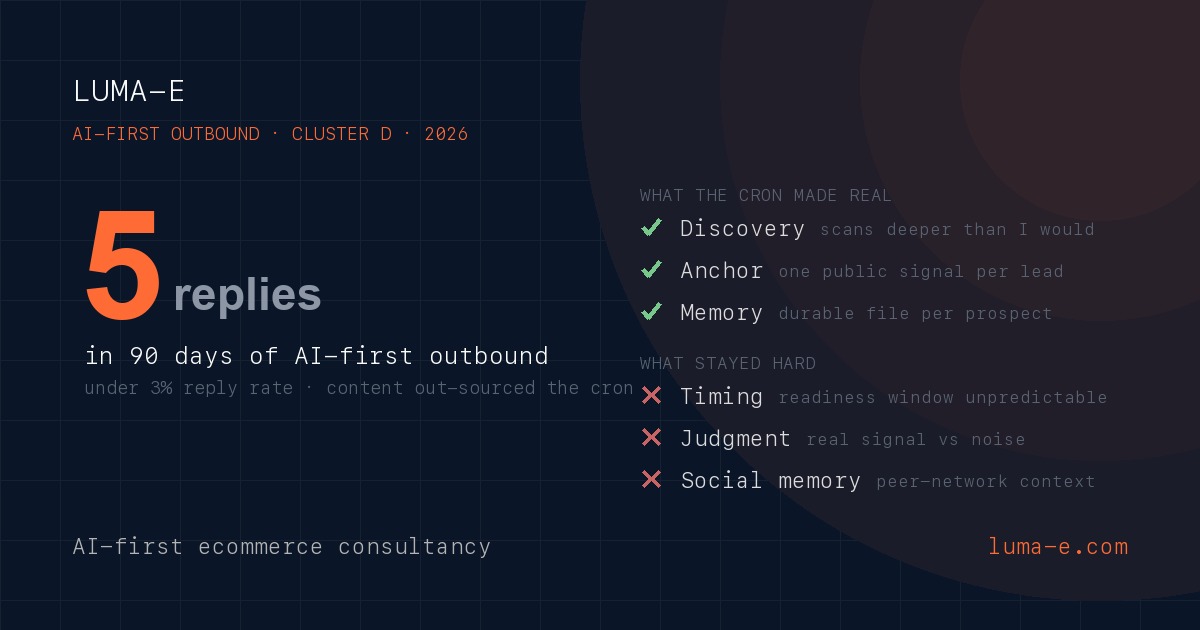
Ninety days ago I replaced my twelve-person agency motion with an AI-first stack, and one of the first things I built inside that stack was a cron-job sales operator. I called him Jack, gave him a Sales Navigator seat, a saved search, a memory file per prospect, and a Monday–Wednesday–Friday six-in-the-morning schedule. Ninety days later he has moved a few thousand rows of prospect state, drafted a few hundred first-touch messages, and produced exactly five substantive replies.
This is the honest write-up. What Jack did, what he could not do, why the reply rate looks the way it does, and what I would change if I were starting the rebuild over today.
#The setup, in one paragraph
Jack is not one agent, he is a cron job. Three mornings a week the scheduled task fires, connects to a saved LinkedIn Sales Navigator search of premium DTC and B2B ecommerce founders, filters returned profiles against an ideal-customer definition stored in a memory file, reads each surviving profile plus their company page for a specific recent signal — a hire, a launch, a category shift, a citation gap in AI search results — drafts a first-touch message that opens on that signal, logs everything to a per-prospect memory file, and hands me three to five ready-to-send drafts inside a codeblock. I paste from the codeblock into LinkedIn manually. He does not send.
The whole thing runs on a scheduled agent that costs less to operate per month than one hour of the outbound rep I used to have.
#What ninety days of Jack looks like on the way in
Volume in the low three digits across the full window. Reply rate that reads under three percent measured against sent. Serious-conversation rate — meaning a reply that led to more than one exchange — closer to one percent.
The five replies that mattered break down like this. Not exact numbers, because the individuals still matter and the framing is the point.
One was a first-degree peer, an ecommerce rollup investor with a mid-five-figure follower count, who commented publicly on one of my founder-voice posts and then engaged in a substantive back-and-forth about the moat question — is the AI-first stack judgment or memory. That thread stayed open for weeks and turned into a portfolio-introduction pathway that has not yet closed but is the highest-quality signal the ninety days produced.
Two were replies to public LinkedIn comments on my content, not to Jack's outbound. A founder in one case, an operator in another, both engaged after the third or fourth post in a cluster, both with substantive first replies. Neither was on Jack's target list at all. Both matter more than any Jack-sourced reply did.
One was a warm dual-vector — the prospect is both a co-founder of a target company and personally runs a seven-figure DTC brand — who responded to a public post with "tell me more" and unlocked a real conversation about a brand-side citation-baseline audit plus an agency white-label angle. That thread came in through content plus a direct message that referenced the content.
The fifth was a mutual introduction from someone Jack had touched two months earlier who quietly pinged back offering to introduce me to a peer in her network. That one felt like a Jack win at first, but the actual reply mechanism was a first-degree relationship the outreach had built without me noticing.
Five substantive replies in ninety days. Two clearly from content, one clearly from content-plus-outbound, one clearly from outbound-then-content, and one clearly from a delayed compound of an early outbound touch. Content is doing more of the work than the outbound volume suggests, and this is not the reply distribution I expected on day one.
#The three parts Jack made real
There are three parts of cold outreach where the cron-job pattern is legitimately better than a human doing the same work at the same volume. I want to be honest about that before I say what did not work.
Discovery. The Sales Navigator search returns hundreds of profiles per run, and Jack scans deeper than I ever did manually — page four, page five, past the first-name founders and into the operators-with-thin-profiles who are actually shipping the interesting product decisions. I would have skimmed page one and stopped. Jack finds prospects on page four that turned into two of the five replies. The depth is a compounding advantage that a tired human at the same seat would not maintain across ninety days.
Anchor-hunting. The one part of first-touch that fatigue destroys is the reading — pulling a specific public signal from each profile and their company page in under a minute per lead. Jack does this cold, at seven in the morning, at a quality that beats my Friday-evening version. The messages are worse than the best ones I have ever written, better than the median ones I have ever written, and consistent, which is what matters at volume.
Memory. Every prospect Jack touches gets a durable file that logs when we last touched, what angle we tried, what the profile said at the time, and what the reply state is. A month later I know without reconstructing that Andy was the peer thread on the Monday post, that Feng replied on Tuesday with "tell me more," that the two Evri leads went silent after four days and were logged cold-stalled on Fri twenty-six. No follow-up window gets dropped because the memory file remembers.
Those three — discovery, anchor-hunting, memory — are the parts I would not go back to a human on if you paid me to. They are worth the whole build even at the reply rate.
#The three parts Jack could not touch
Timing. The cron sends on a schedule. Prospects reply when they are ready. Those two clocks are not correlated. Ninety days in I have found no signal that reliably predicts a prospect's readiness window more than two weeks out. The best I can do is push a follow-up window on a warm signal and hope the second touch lands inside the ten days after the first read. Jack made this hygiene work reliably. He did not make it work causally.
Judgment on whether a warm signal is real or noise. A profile view. An accept without a reply. A public comment. Every one of these produces a decision — do I treat this as a warm signal and escalate, or as an intent-only touch and stay silent. Jack surfaces every signal. I still have to sort them, and the sorting takes a level of context — who does this person report to, what did they just ship, what is happening at their company right now — that Jack cannot piece together across three engines and a Sales Nav profile alone. I do this part myself, at a rate of maybe fifteen minutes per morning, and I have not automated it because every attempt has produced the same failure mode: the automation elevates the wrong signal about one time in five.
Social memory across a peer network. Knowing that the person you are about to message just got introduced to someone in your first-degree network by a mutual referral last week is the kind of context that changes the correct opener entirely. It sits inside first-degree connection posts, comments, likes, warm-intro chains, and offhand messages, and no combination of scans I have tried reconstructs it reliably. The result is that Jack sometimes writes to a prospect I should have asked for a warm intro to instead — three times, that I know of, in ninety days.
Those three — timing, judgment, social memory — stayed hard. They are the parts that make cold outreach feel like sales instead of scanning.
#What the reply distribution changed my mind on
If the ninety-day distribution had come out the way I expected on day one — most replies sourced by the outbound cron, content as a supporting layer — I would have doubled Jack's volume in week five and started building the next agent on top of him.
Instead two of the five replies came directly from content, one came from content plus a message that referenced the content, one came from an outbound touch followed by a content pickup, and one came from a delayed compound of an early outbound touch. Four of the five substantive threads had content in the mechanism. That is not a "cold does not work" conclusion. It is a "cold is one layer of a compound and the other layer is doing more work" conclusion.
I cut the daily cold cap from a starting five to a working three in week eight, held that limit for the rest of the ninety days, and shifted the freed cron time into content cluster production — an AI Visibility cluster, a Shopify Plus B2B cluster, a Solo-plus-AI operations cluster, each with a blog cadence and a LinkedIn reply-monitor cadence sitting on top. That reallocation matched where the actual replies were coming from, and the reply distribution over the next thirty days confirmed the direction.
#What I would rebuild the same way
The discovery-anchor-log spine. Cron-scheduled, memory-file-per-prospect, drafts-in-codeblocks, human on the send. Every part of that stayed valuable across ninety days and I would build it the same way if I started over tomorrow.
The version rules. No fabricated stats in messages. No pricing speculation before a scope conversation. No case-study references that leak dollar amounts or internal project codes. No fifteen-minute-call CTA in first touches — lead with async value or don't touch. Every one of those started as a spec line and ended as a regex-scannable pre-send check that Jack runs before he prints a draft. Those checks caught real errors and I would keep every one of them.
The propose-confirm cycle. Weekly on Saturday morning Jack proposes the next week's ideal-customer definition, cluster ratio, and volume cap, and I approve on Sunday night. Autonomy inside the approved boundaries, no drift on the boundaries themselves. That structure kept ninety days coherent when the temptation on any given Tuesday was to chase a shiny thread and let the plan slip.
#What I would rebuild differently
The volume assumption. If I started over today I would cap cold outbound at three to five per week from the start rather than working down to three from an aggressive five per day. The freed cron time would go to content-cluster production and public reply monitoring from day one, because that is where the reply distribution says the actual conversations come from. The cron-outbound agent stays in the stack as a hygiene layer — it keeps the pipeline warm and the memory files honest — but it is not the top of funnel it looked like on paper.
The peer-network scan. Building the social-memory layer earlier, so that Jack knows on Monday morning who in the first-degree network just posted about the target industry, who commented on whose thing, who introduced whom. That layer would have caught at least three prospects Jack messaged cold when I should have gone through a warm intro. Not building it earlier is the biggest thing I would change.
The content-outbound coupling. Content did more of the sourcing work than the outbound cron did. If the two are that coupled, they should be planned together — the Monday blog and the Monday outbound should reference the same specific claim so a warm signal from either can compound the other. I ran them as parallel tracks for eighty days. They should have been coupled from day one.
#What a founder considering this should take away
If you are thinking about running a cron-job sales operator, three things worth stealing from the ninety-day version.
One, the reply rate will look lower than the demos say. Under three percent measured against sent volume is a real number from a real ninety-day window with a competent cron and a target segment that fits. If your demos are quoting ten percent to you, the demos are cherry-picked windows or the segment is different from yours.
Two, the value is in the discovery-anchor-log spine, not the volume. A cron that finds you deeper prospects, writes them a specific anchored first touch, and remembers what happened next is worth building even if you send three per week. A cron that lets you send fifty per week is not more valuable — it is one restriction away from wiping out the discovery-anchor-log spine you actually needed.
Three, content will do more of the sourcing than you think. Budget accordingly. If you have to choose between one more outbound touch per day and one more piece of content per week, choose the content, and let the outbound cron pick up the warm signals content produces. That is the direction the ninety-day distribution moved, and the direction the next ninety are pointed.
#Sources
Internal citation and reply logs from LUMA·E's ninety-day rebuild, referenced in the AI Visibility Audit Workbook self-score walkthrough and the zero-to-two AI citations thirty-day log. External anchor: Ahrefs best-lists-research for the reply-attribution framing of content-sourced versus outbound-sourced pipeline.