The 5 Schema Types ChatGPT Actually Reads in Ecommerce (2026)
Jump to section›
#Short answer
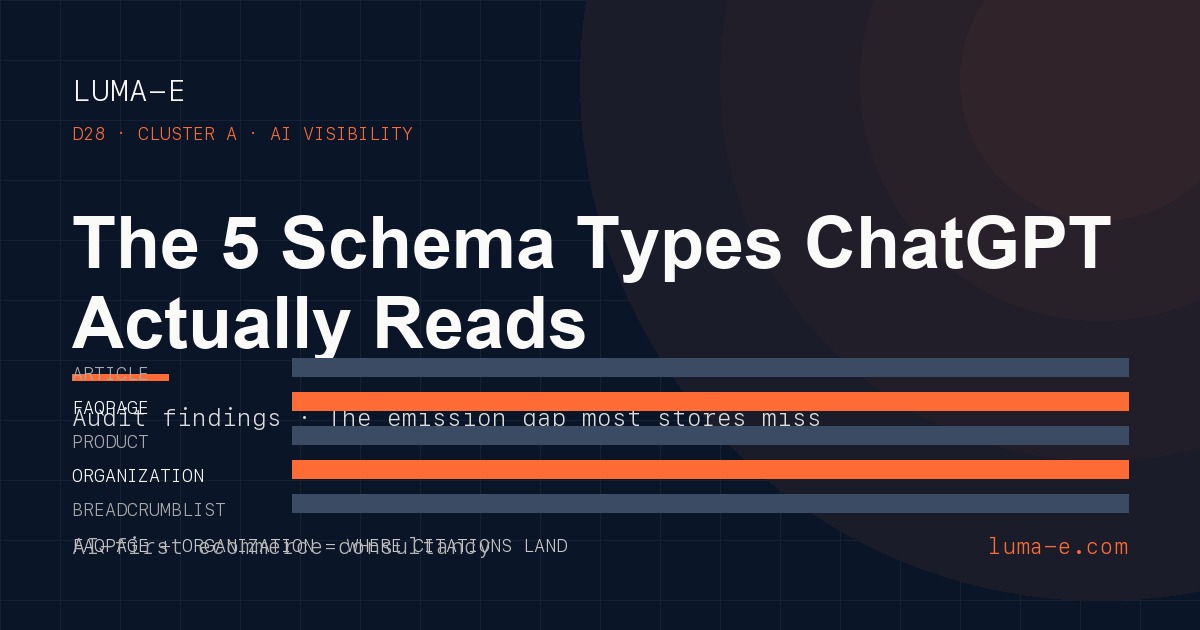
Schema.org defines hundreds of types, but in ecommerce only five reliably show up where AI engines compose answers: Article, FAQPage, Product, Organization, and BreadcrumbList. The rest are mostly noise for AI citation. And having these five in your theme is not the same as emitting them — the most common failure we find isn't a missing schema, it's a schema that renders visually but never reaches the page as JSON-LD. This post breaks down what each of the five does, which two most stores quietly skip, and the one-line check that tells you whether you're emitting schema or just displaying it.
These observations come from auditing structured data across 50+ ecommerce projects, cross-referenced with what's publicly known about how AI engines source their citations.
#The five, ranked by what they do for AI citation
- Article — gives the engine a clean, self-contained passage to lift and attribute.
- FAQPage — question-answer pairs get pulled nearly verbatim into AI answers.
- Product — anchors price, availability, and review signals to a named item.
- Organization — with sameAs links, makes your brand a recognized entity, not just a string.
- BreadcrumbList — tells the engine how your content is structured.
The two most stores skip, in their most valuable form: Organization with real sameAs links, and FAQPage emitted as actual JSON-LD rather than a visual accordion.
#Why these five and not the other hundreds
AI engines don't reward schema for its own sake. They reward schema that helps them do one of two jobs: extract a passage they can attribute, or recognize an entity they can trust. Every type on the list above maps to one of those jobs.
This matters because of how citations are actually sourced. Per the Ahrefs December 2025 study of 26,283 source URLs, 43.8% of ChatGPT citations come from listicle-style content — "best X for Y" aggregator pages (Ahrefs, December 2025). So a large share of head-query citations doesn't come from your own pages at all; it comes from directories that list you. That's an entity-recognition job, and it's why Organization schema with sameAs links punches above its weight: it's part of what makes an engine connect "your brand on a Clutch list" to "your brand's own site" to "your brand as a known entity."
For the citations that do come from your own pages, the extraction job dominates — and that's where Article and FAQPage earn their place. Everything else is supporting structure.
#Schema type 1 — Article
Article is the workhorse for content pages. It hands the engine a bounded, attributable block of text with an author, a publish date, and a headline. When an AI answer lifts a sentence or two from a blog post and attributes it, Article schema is usually what made that clean extraction possible.
The common gap isn't absence — it's incompleteness. An Article block with a headline but no author (as a Person, not a bare string) and no datePublished gives the engine less to anchor on. Pair Article with a real Person schema for the author and you strengthen both the passage and the entity behind it.
#Schema type 2 — FAQPage
FAQPage is the single highest-leverage schema for AI search in ecommerce, and the one most commonly broken. ChatGPT, Perplexity, Claude, and Google's AI Overviews all parse FAQPage JSON-LD cleanly and lift question-answer pairs nearly verbatim into their answers. A well-structured FAQ section is, in effect, pre-formatted citation bait.
The failure mode is specific and widespread: the FAQ renders as a visual accordion but the FAQPage JSON-LD is never emitted. Human readers see a tidy FAQ; engines parsing structured data see nothing. The content exists and doesn't exist at the same time, depending on who's reading.
The check takes ten seconds:
curl -s https://yourstore.com/your-page | grep '"@type":"FAQPage"'
Empty result means an emission gap. Closing it is typically 10 to 20 lines of template code — one of the best effort-to-impact trades in the whole discipline.
#Schema type 3 — Product
Product schema anchors the commercial facts — price, availability, ratings, reviews — to a named item. For ecommerce this is table stakes, and most stores on mature platforms emit at least a basic version because the platform ships it.
Where it gets thin: review and rating fields left empty, brand missing, or offers not reflecting real availability. Product schema's value for AI citation is that it lets an engine answer a specific commercial question ("is X in stock," "what does X cost," "how is X rated") with attributable structured facts rather than a guess. Half-populated Product schema answers half the question.
#Schema type 4 — Organization
Organization is where the biggest, quietest gap lives. Almost every store emits an Organization block — name, logo, maybe a URL. Very few emit the version that actually builds entity authority.
The valuable form carries:
sameAs— links to your authoritative profiles (LinkedIn, YouTube, Crunchbase, and the like). This is the connective tissue that lets an engine recognize your brand as one entity across the web instead of a series of unconnected mentions.knowsAbout— the topics your organization is an authority on.- A consistent NAP (name, address, phone) that matches your directory profiles.
Without sameAs, your brand is a string. With it, your brand is an entity — and entities are what AI engines prefer to cite. Given that 43.8% of citations route through aggregator listicles, the recognizability that Organization schema builds is what determines whether you show up as a known brand on those lists.
#Schema type 5 — BreadcrumbList
BreadcrumbList is the least glamorous of the five and still worth shipping. It tells the engine how a page sits in your site's hierarchy — category, subcategory, item — which helps it understand context and relationships between pages. It won't single-handedly win a citation, but it's cheap, it's clean, and it contributes to the structural picture the engine builds of your site. Skip it and you leave a small, free signal on the table.
#The check that matters more than the list
Knowing the five types is the easy part. The discipline that separates stores that get cited from stores that don't is verifying emission on the rendered page, not assuming the theme handles it.
Run this across each page type — homepage, a product page, a content page:
for type in Article FAQPage Product Organization BreadcrumbList; do
  echo -n "$type: "
  curl -s https://yourstore.com/your-page | grep -c "\"@type\":\"$type\""
done
A zero where you expected a one is a gap. Fix it at the template level — 10 to 30 lines per template depending on your stack — then validate once with the Google Rich Results test or the Schema.org validator, and add a regression check to your build so a future template change can't silently drop the schema.
#The pattern across audits
The stores that get cited aren't the ones with the most schema. They're the ones that emit the right five, completely, and verify it on the live page. Across 50+ projects the recurring story is the same: the schema is half-present (FAQs displayed but not emitted), or half-complete (Organization without sameAs), and closing those two gaps alone moves the needle more than any volume of new markup.
If you want a second set of eyes on which of the five your store is actually emitting versus only displaying, that's exactly what our async AI Visibility teardown checks — we run the emission test across your page types and send back the gaps with the template fix for each, no call required.
#Sources
- Ahrefs — Do Self-Promotional "Best" Lists Boost ChatGPT Visibility? Study of 26,283 Source URLs (43.8% of ChatGPT citations from listicle-style content)
- Schema.org — Article, FAQPage, Product, Organization, BreadcrumbList (type reference)
- Google — Rich Results Test · Schema.org — Validator (emission verification)